Selling Your Home What You Should Know About Price Cuts vs. Rate Buydowns.

Kim Deol • November 18, 2026

In today’s market, a growing number of sellers are opting to do something called a price cut – especially when their house has been on the market for a while without any bites.


According to HousingWire Data as many as 4 in 10 (43%) sellers are going this route – that’s the highest it’s been in 4 years. But what if there’s another (potentially better option) for your bottom line? And it’s just as appealing, if not more so, to today’s buyers?

Enter the rate buydown.

Why Buyers Expect a Deal

First, let’s set the stage on why some compromise may be necessary in today’s market.


In September, Redfin says there were 63% more sellers than buyers in the market. And with so many sellers active and relatively few buyers by comparison, those purchasers are realizing they have more power. And as mortgage rates continue to put a squeeze on their budgets, they’re leaning in and using it.

One of the most common negotiation points? The price.


That’s because they want to feel like they’re getting a deal and they want to see their monthly payment drop. And since buyers can’t control rates, the price feels like the most obvious lever to pull.


But the savviest sellers realize being flexible doesn’t always mean a lower price, paying for a buyer’s rate buydown might work better.

What Is a Rate Buydown?

A buydown is money paid at closing to lower the buyer’s mortgage rate. When you pay it as the seller, you are paying some of the buyer’s interest ahead of time, so the buyer gets a lower rate and monthly payment. And that’s especially appealing to today’s buyers.


  • Temporary buydowns lower the rate for the first few years, then it goes back to the full rate. The more years a buydown covers, the more it costs. These work well for buyers who expect to refinance within a certain amount of time.
  • A permanent buydown lowers the rate for the whole loan. These are paid for with “discount points.” One point costs 1% of the loan. According to FICO, each point generally lowers the rate by about a quarter of a percent. This type of buydown works well for buyers who plan to stay in the home for a long time.

Same Money, Different Results

And here’s why these can be a win-win for both buyers and sellers. Rate buydowns help sellers stand out in a crowded market and they can have a bigger impact on your buyer than a price cut would.


Here’s an example to show you what that could look like.


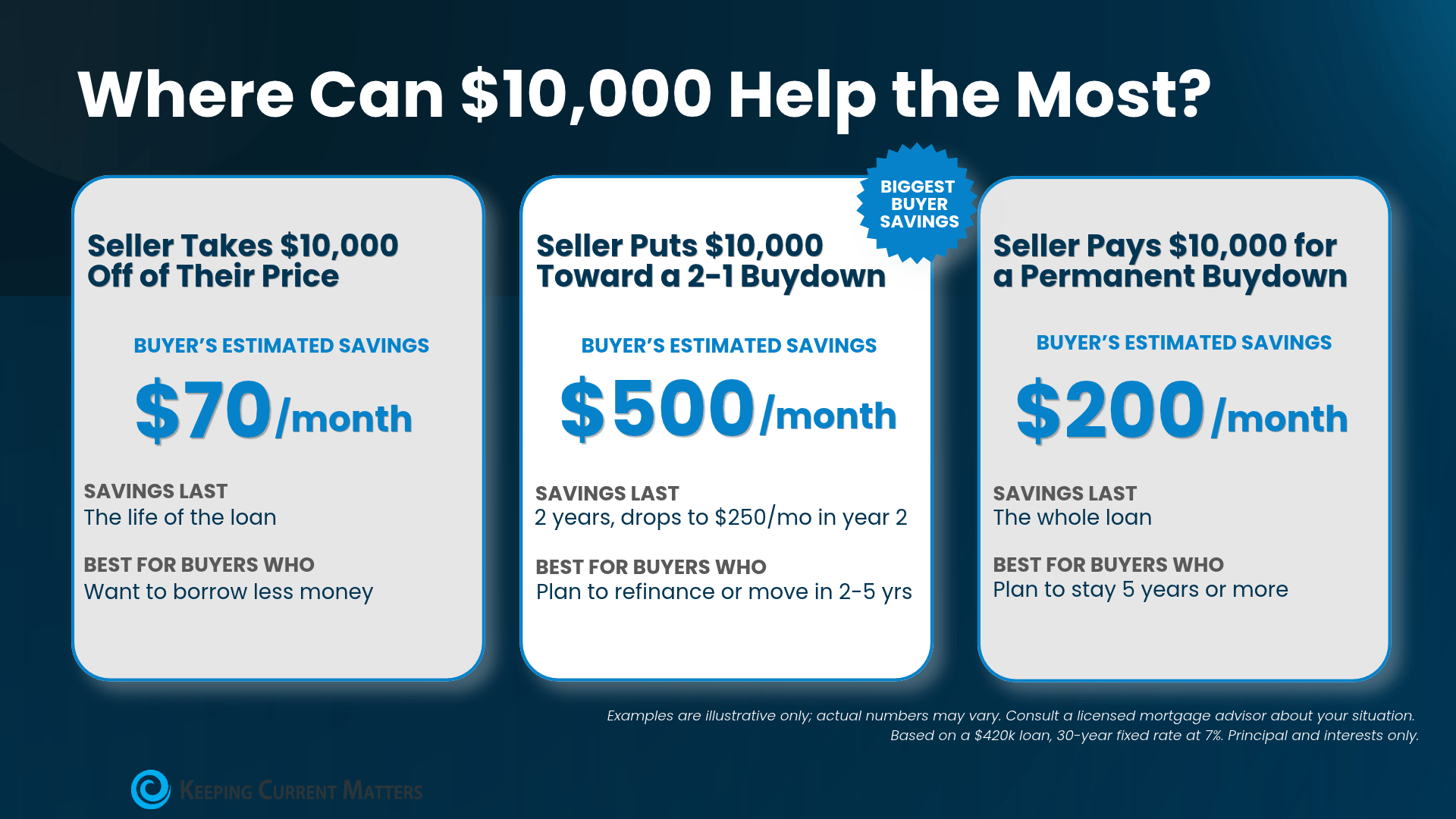
Let’s say you’re willing to make a $10,000 concession to help get the deal done. Take a look at these three ways to spend that money and the impact they could have on a buyer’s $420,000, 30-year fixed loan at 7%:
Bar chart ranks common seller projects before listing: deep cleaning leads, followed by painting, decluttering, landscaping, repairs, and staging.

It’s the same $10,000 from the seller. But a 2-1 buydown saves the buyer about eight times more each month in the first year.


And since most buyers shop by monthly payment, that’s what grabs their attention.


That’s what makes a rate buydown worth considering. Instead of reducing your asking price, you may be able to use that same money to have a bigger impact on your buyer’s monthly payments. And depending on what matters most to that buyer, the immediate savings could be more appealing than a price reduction.


The key is working with your agent and the buyer’s lender to compare the options and see which one makes the most sense.

Things To Know

  • Loan programs cap how much a seller can pay toward a buyer’s costs.
  • Money toward buydowns doesn’t limit what else a buyer may ask a seller to pay for. Buyers may still ask for repairs or other concessions.
  • Putting the buydown offer in your listing lets agents and buyers know it’s an option.
  • Your agent can run scenarios on buydowns and other costs of selling in advance so you’re prepared when an offer comes in.
November 17, 2026
If selling your house is on your calendar for 2027, you may be thinking you’ve got plenty of time. Maybe you’re aiming for January. Maybe you’re waiting for spring. Either way, next year probably feels far enough away that getting ready can wait, too. But waiting until 2027 to sell doesn’t mean waiting until 2027 t
By Kim Deol • November 11, 2026
Buying a condo can be a great way to become a homeowner without all the maintenance and responsibilities that come with owning a single-family home. But before you fall in love with the perfect unit, there are a few important things to consider. Here are 10 things every condo buyer should know before making an offer! 1. HOA Fees Monthly HOA fees can vary significantly. Find out what they cover, such as exterior maintenance, landscaping, insurance, pools, gyms, and common areas. 2. HOA Financial Health Review the HOA's financial statements, reserve funds, budget, and upcoming expenses. A poorly funded HOA could mean unexpected costs down the road. 3. Special Assessments Ask whether there are any current or upcoming special assessments. These are additional charges owners may have to pay for major repairs or improvements. 4. Condo Rules and Restrictions Every HOA has its own rules. Review restrictions regarding pets, rentals, parking, renovations, noise, and use of common areas. 5. Parking and Storage Confirm how many parking spaces come with the unit and whether they are assigned, deeded, or shared. Check for additional storage options. 6. Location and Neighborhood Consider proximity to shopping, restaurants, schools, public transportation, and major commuting routes. Location still plays a major role in resale value. 7. Insurance Coverage Understand what the HOA's master insurance policy covers and what you'll need to insure separately through an individual condo policy. 8. Financing and Lender Approval Not every condo qualifies for every type of financing. Have your lender review the condominium project early to identify any potential financing restrictions. 9. Maintenance and Building Condition Look beyond the unit itself. Check the roof, plumbing, elevators, balconies, exterior, and shared facilities. Building maintenance can affect your future costs. 10. Resale Value and Rental Restrictions Think about your long-term plans. Research comparable condo sales, rental restrictions, owner-occupancy requirements, and demand in the area.
By Kim Deol • November 5, 2026
Diwali, also known as the Festival of Lights, is one of the most celebrated holidays around the world. This beautiful tradition symbolizes the victory of light over darkness, good over evil, and hope over despair. Celebrated by millions of people, Diwali is a time for families and friends to come together, decorate their homes with glowing lights and colorful rangoli, enjoy delicious traditional foods, exchange gifts, and create lasting memories. A Time to Celebrate Home & Family At the heart of Diwali is the feeling of home. Families gather, homes are beautifully decorated, and traditions are passed down from one generation to the next. It's a reminder that home is more than just a place to live—it's where we celebrate, connect, and make memories with the people who matter most. Celebrating Diversity in the Tri-Valley Here in the Tri-Valley, we are fortunate to be part of such a diverse and welcoming community. From Dublin and Pleasanton to Livermore and San Ramon, Diwali is a wonderful opportunity to celebrate different cultures, traditions, and the connections that bring our community together. Whether you're celebrating with family, attending local festivities, or simply enjoying the beautiful lights, may this season bring happiness, prosperity, and new opportunities. Wishing You a Bright & Beautiful Diwali!  May your home be filled with laughter, your heart with happiness, and your year ahead with health, success, and prosperity. Happy Diwali to you and your loved ones! 🪔✨